

34 controlled trials
A systematic review finding consistent associations between gut microbiota composition and anxiety levels across the studies examined.
Two products. One standard. The research behind them, the ingredients inside them, and nothing added for the sake of a longer label.

At Lunara Labs, every formulation begins in the published literature. We read the studies. We ask whether the research is robust, whether the doses are meaningful, whether the forms are bioavailable, and only then decide what goes into a capsule.
This is the science we work from. Not a simplified version of it.
Your gut is a second brain. The research says so.
The enteric nervous system, the neural network lining the gastrointestinal tract, contains an estimated 500 million neurons. That is more than either the spinal cord or the peripheral nervous system.
The gut and brain stay in constant, bidirectional communication through the gut-brain axis: neural, hormonal, and immunological pathways connecting the digestive system to the central nervous system. At the centre of that communication is the vagus nerve, running from the brainstem to the abdomen and carrying signals in both directions.
What travels along those pathways is shaped, to a remarkable degree, by the microorganisms living in the gut.
Mayer EA et al., J Clinical Investigation, 2015 · Furness JB et al., Nat Rev Neurosci, 2011 · Breit S et al., Frontiers in Neuroscience, 2018
You are, in the most literal sense, a community.
The human gut microbiome contains an estimated 38 trillion microbial cells, roughly equal in number to the cells in the rest of the body. This community metabolises nutrients, regulates immune function, produces compounds that influence inflammation, and synthesises molecules the body cannot make on its own.
Among the most significant are neurotransmitters. Research published in Cell (2015) showed that specific gut bacteria are responsible for a substantial proportion of the body's serotonin biosynthesis. Approximately 90–95% of the body's serotonin is produced in the gut, not the brain.
A landmark study in PNAS (2011) showed that Lactobacillus rhamnosus altered GABA receptor expression in the brain through the vagus nerve. Those effects disappeared when the vagus nerve was severed, confirming the pathway.
Yano JM et al., Cell, 2015 · Bravo JA et al., PNAS, 2011 · Strandwitz P, Brain Research, 2018
One of the most significant areas of emerging research in medicine.
A systematic review finding consistent associations between gut microbiota composition and anxiety levels across the studies examined.
A meta-analysis reporting reductions in psychological distress outcomes across animal and human subjects.
The first randomised controlled trial to show that a dietary intervention supporting the gut microbiome produced significant reductions in depressive symptoms.
This is not fringe science. It is peer-reviewed, replicated, and increasingly central to how mood, cognition, and emotional resilience are understood.
The mechanisms proposed include microbial modulation of the HPA axis and cortisol, production of short-chain fatty acids that influence brain function, regulation of intestinal permeability, and direct signalling via the vagus nerve.
Research in Psychopharmacology (2015) found that prebiotic supplementation reduced the waking cortisol response and shifted attention away from negative stimuli in healthy volunteers.
Yang B et al., General Psychiatry, 2019 · Jacka FN et al., BMC Medicine, 2017 · Schmidt K et al., Psychopharmacology, 2015
The decade between 35 and 45 is rarely described as a period of biological transition, but it is. Subtle hormonal shifts begin well before the clinical definition of perimenopause, and they do not happen in isolation from the gut.
This is why gut health in women 30+ is not a lifestyle preference. It is a physiological priority.
A subset of gut bacteria responsible for metabolising and recirculating oestrogens. When microbial diversity is disrupted, oestrogen metabolism can become dysregulated. Effects on mood, energy, skin, and sleep are increasingly well documented.
Chronic psychological stress alters gut microbial composition through elevated cortisol and reduced mucosal integrity. A stressed mind changes the gut, and a disrupted gut changes the mind.
Hormonal fluctuations of perimenopause, alongside antibiotic use, processed food, and chronic stress, can reduce microbial diversity. Diversity is the most important measurable feature of a healthy gut microbiome.
Disruption to the gut lining has been associated with systemic inflammation, and identified in research as a pathway linking gut dysbiosis to depressive symptoms.
A probiotic without a prebiotic is an incomplete formula.
A fructooligosaccharide. It resists digestion in the upper gut and arrives intact in the colon.
It feeds Bifidobacterium and Lactobacillus specifically, rather than harmful bacteria.
Including butyrate, which supports the gut lining and has demonstrated anti-inflammatory properties.
Probiotic strains paired with their preferred substrate. That pairing can improve survival through the gut and colonisation lower down.
Inulin from chicory root is one of the most researched prebiotic fibres in the literature. As a fructooligosaccharide, it is a selective fermentation substrate: it preferentially feeds beneficial bacterial species.
The distinction between a probiotic and a synbiotic, probiotics and prebiotics formulated together, matters. Evidence suggests pairing specific strains with the fibres they ferment may enhance bacterial survival during transit and support colonisation in the lower gut.
Gibson GR et al., Nat Rev Gastroenterol, 2017 · Vandeputte D et al., Nature Microbiology, 2017
If the evidence is not there, the ingredient is not in the formula. Both products are manufactured in the UK to GMP standards.
A published body of evidence for the proposed role. Not tradition, and not a trend.
A meaningful amount, consistent with the research. Not a trace added so it can appear on the label.
The form matters as much as the ingredient. We use forms the body can absorb and use.
No claim beyond what the evidence supports. Written for women who read the label.
Every product. Every batch.
Every incoming ingredient is checked for identity, purity, and potency before it enters production.
Records run from blending through encapsulation. Every step is documented.
Final testing confirms that what is on the label is what is in the capsule, with traceability from ingredient to shelf.
Discover the key ingredients in our formulas and why they matter.


We select high-quality ingredients and combine them with care, based on research and real women's needs.
View all products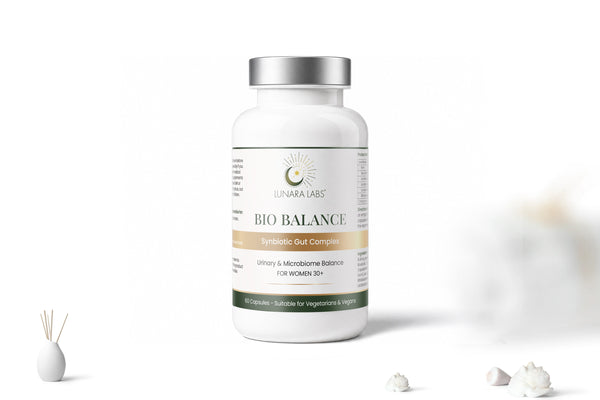
Suitable for Vegetarians & Vegans
Subscribe £46.99
One-time £54.99
60 Capsules / 60-day supply
View product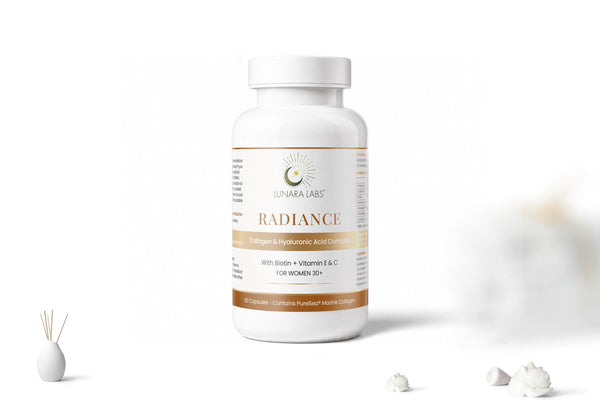
Contains Marine Collagen (Fish) — Not suitable for vegans or vegetarians
Subscribe £43.99
One-time £51.99
60 Capsules / 60-day supply
View productCan't find what you're looking for? We're here to help.
View all FAQsBio Balance is a synbiotic gut complex: five live bacterial strains with chicory inulin prebiotic fibre. It is formulated for daily use by women 30+.
Bio Balance: one capsule daily on an empty stomach, with water. Do not take it with hot drinks or food. Radiance: one capsule daily with food.
Bio Balance is suitable for vegetarians and vegans. Radiance contains marine collagen, so it is not vegan.
Both products are manufactured in the UK to GMP standards. Each ingredient is there for a studied role, at a dose that matches that role.
Not recommended during pregnancy, or if you are under medical supervision, without speaking to a healthcare practitioner first.